The landscape of creative expression is constantly evolving, and among the most intriguing shifts is how technology is becoming a muse. Indeed, the Creative Applications of Poetry Generators are unlocking entirely new poetic possibilities, transforming the act of writing verse from a solitary endeavor into a dynamic partnership between human insight and artificial intelligence. Forget clunky algorithms; modern AI is crafting everything from soulful sonnets to evocative haikus, offering poets, writers, and even casual wordsmiths an unprecedented toolkit for exploration and innovation.
Imagine a digital collaborator that never sleeps, offering fresh perspectives, unraveling creative knots, and helping you sculpt words with a precision and depth previously unimaginable. That's the promise of today's sophisticated poetry generators.
At a Glance: What You'll Discover
- How AI poetry generators function as more than just word-spinners, leveraging deep learning and natural language processing.
- Practical ways to use these tools to overcome writer's block, explore new forms, and refine your poetic voice.
- A breakdown of leading AI tools like Sudowrite, Jasper AI, and ChatGPT, and their unique strengths.
- Strategies for collaborating effectively with AI to maintain emotional authenticity and personal perspective.
- Insights into the future of AI-assisted poetry and ongoing discussions around authorship and originality.
The Dawn of the Digital Muse: Understanding Poetry Generators
For centuries, poetry has been a profoundly human art form, a reflection of our deepest emotions, observations, and insights. Today, advanced language models are stepping into this hallowed space, not to replace the human poet, but to augment and inspire. At their core, modern poetry generators are powered by sophisticated deep learning models, like the renowned GPT-3, and advanced natural language processing (NLP). These systems are trained on vast collections of existing poetry, dissecting linguistic patterns, rhythmic structures, and the emotional nuances of countless verses.
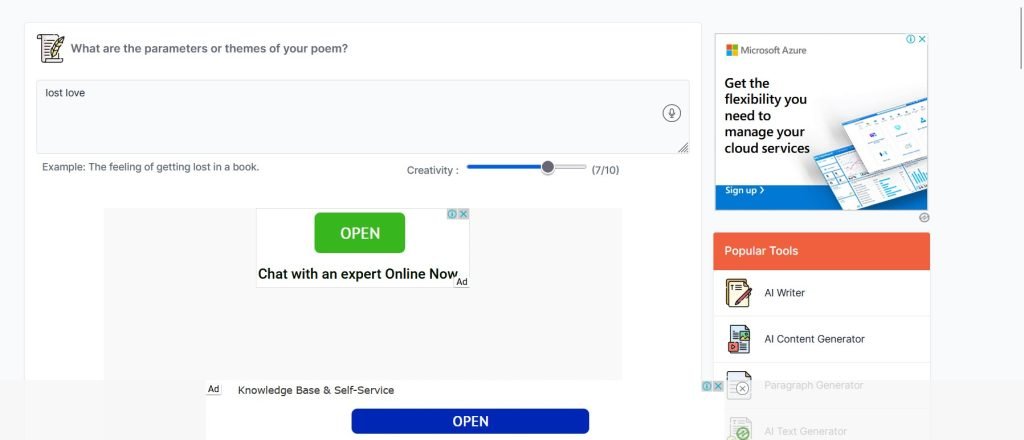
They learn to understand meter, rhyme, alliteration, and even the subtle art of metaphor. When you provide a theme or topic, the AI doesn't just pull words from a dictionary; it analyzes the sentiment you're aiming for and leverages reinforcement learning to refine its output, generating original verses that strive for coherence, beauty, and emotional resonance. Many platforms, including our poetry generator tool, make this powerful technology accessible, allowing you to quickly craft unique poems, haikus, sonnets, and more based on your specific prompts. This technology significantly expands the poetic landscape, offering new avenues for creative expression.
Beyond the Blank Page: Practical Creative Applications
The true magic of poetry generators lies in their diverse applications. They're not just for creating a quick verse; they're dynamic partners in the entire creative process, pushing boundaries and sparking innovation.
Overcoming Writer's Block and Sparking Initial Ideas
One of the most common foes for any writer is the dreaded blank page. Poetry generators act as instant brainstorming partners. Feeling stuck on a specific theme or emotion? Feed it into an AI tool, and it can generate initial drafts or a burst of fresh perspectives. Tools like Sudowrite excel at generating emotionally resonant verses, providing that vital kickstart when inspiration wanes, while InferKit offers real-time creative guidance as you type, helping to shape nascent ideas into coherent lines. It’s like having an infinite well of starting points.
Exploring New Forms, Structures, and Styles
Ever wanted to write a sonnet but felt intimidated by the structure? Or perhaps you're curious how a haiku might express a complex idea? AI tools offer a low-stakes environment for experimentation.
- Traditional Forms: Jasper AI specializes in crafting traditional structures, metered verses, and classic forms like sonnets and haikus, ensuring adherence to strict conventions.
- Versatile Templates: Rytr offers versatile templates for various poetic forms, allowing you to experiment with different structures and discover what best fits your message.
- Free Verse Exploration: Even for free verse, generators can offer unexpected juxtapositions or compelling imagery, helping you break out of habitual thought patterns.
- Style Mimicry: Some advanced tools can even mimic specific poetic styles, allowing you to experiment with voices beyond your own, expanding your versatility.
This capability democratizes access to complex poetic forms, allowing more writers to engage with and master them.
Refining Imagery, Rhythm, and Poetic Devices
Poetry isn't just about words; it's about how those words sound and feel together. AI poetry companions can act as your digital muses, offering real-time guidance on rhythm, imagery, and structure.
- Real-time Feedback: They can analyze your input and suggest alternative phrases, stronger verbs, or more evocative metaphors.
- Meter and Rhyme Schemes: For those working with traditional forms, AI tools provide detailed feedback on meter, rhyme schemes, and stanzaic forms, helping you maintain consistency and polish. They function as automated thesauruses and rhyming dictionaries, ensuring your rhymes are fresh and your language precise.
- Sentiment Analysis: When crafting an emotional piece, AI systems can even employ sentiment analysis to help you gauge and refine the emotional impact of your words, ensuring your poem truly resonates.
Facilitating Collaborative Writing
Poetry, traditionally a solitary art, can now become a collaborative venture. Tools like Copy.ai and ChatGPT revolutionize collaboration by allowing multiple users to contribute ideas, generate alternative lines, and refine verses together. Imagine a writing group where an AI can instantly generate variations on a theme or expand on a single line, allowing human collaborators to pick the best and continue building. This extensive writing support and versatility in creative expression make these platforms invaluable for shared projects or even just bouncing ideas off a digital partner.
Learning and Academic Exploration
Beyond direct creation, AI poetry tools offer significant educational benefits.
- Explaining Complex Forms: They can explain complex poetic forms, demystifying the rules of a villanelle or the cadence of blank verse.
- Literary Analysis: AI can analyze literary texts, identify themes, and even generate analytical essays, providing statistical insights into poetic patterns across vast collections.
- Classroom Aid: In academic settings, they can offer immediate feedback on drafts, helping students understand concepts like meter and imagery in a practical way.
- Multilingual Support: For those interested in the global poetic landscape, tools like Rytr support multiple languages, allowing for translation, comparative analysis, and poetry generation across linguistic boundaries.
A Closer Look: Tools Shaping the Poetic Landscape
The market for AI poetry generators is growing, each offering unique strengths. Here’s how some of the leading tools mentioned in our research stack up:
- tinypoetry.com AI-Powered Poem Generator: This is an excellent starting point, especially if you're looking for a free tool that requires no sign-up. It's user-friendly and capable of crafting unique poems, haikus, sonnets, and free verse based on a simple theme. It serves as a great introduction to the capabilities of advanced language models in understanding rhythm and poetic devices.
- Sudowrite: Known for its ability to delve into emotional depth, Sudowrite is a powerful ally for writers seeking to generate emotionally resonant verses and initial drafts. It helps infuse feelings into your poetry, making it a favorite for personal and expressive pieces.
- InferKit: This tool stands out for providing real-time creative guidance. As you write, InferKit can offer suggestions and continue your lines, acting as an instant co-pilot that helps you navigate your creative flow and overcome momentary blocks.
- Rytr: Versatility is Rytr's strong suit. With various templates for different poetic forms and support for multiple languages, it's ideal for poets who enjoy experimenting with structure and reaching diverse audiences.
- Grammarly’s AI Poetry Generator: While often associated with grammar checks, Grammarly also offers a free, customizable AI poetry generator. Beyond creation, it serves as an excellent final checkpoint for technical polish, ensuring your AI-assisted poems are grammatically sound and structurally coherent.
- Jasper AI: If you're a purist who appreciates classic forms, Jasper AI is your go-to. It specializes in crafting traditional structures, metered verses, and classic forms like sonnets and haikus with impressive accuracy and elegance.
- Copy.ai & ChatGPT: These two platforms are champions of collaboration and extensive writing support. Their versatility in creative expression makes them excellent for brainstorming, generating multiple variations, or engaging in a back-and-forth creative dialogue with the AI. They're like expansive digital notebooks always ready to assist.
Many of these platforms offer both free and premium options, providing access to sophisticated content generation capabilities while often maintaining impressive emotional depth.
The Art of Partnership: Mastering AI Poetry Tools
It's critical to approach AI poetry tools not as replacements for human creativity but as collaborative partners. The goal isn't to let the AI do all the work, but to integrate AI-generated ideas with your personal voice, unique perspective, and human refinement.
AI as Your Co-Pilot, Not Your Captain
Think of AI as a highly skilled assistant. It can provide prompts, suggest structures, offer alternative phrasing, and even generate entire stanzas. But the final curation, the emotional authenticity, the unique perspective that makes a poem truly memorable – that still comes from you.
- Infuse Your Voice: Always bring your unique experiences, emotions, and specific stylistic choices to the AI's output. Use its suggestions as a springboard, then reshape them to truly reflect your artistic vision.
- Refine and Polish: AI output can sometimes be generic or lack the subtle nuances of human language. Your job is to refine, prune, and elevate the generated text, ensuring every word serves your artistic intent.
- Emotional Authenticity: While AI can simulate emotional resonance through sentiment analysis, it cannot replicate genuine human feeling. It's your personal touch that imbues the poem with authentic emotion, making it relatable and powerful.
Pitfalls to Avoid
- Over-reliance: Don't let the AI dictate your entire creative process. Maintain control and use the tool selectively to enhance, not diminish, your agency.
- Generic Output: Without human intervention, AI-generated poetry can sometimes feel bland or formulaic. Always review critically and infuse your unique sparkle.
- Lack of Context: While AI understands patterns, it doesn't understand the lived experience behind a poem. Be prepared to provide that crucial context and meaning.
Mastering these tools means understanding their capabilities and their limitations, leveraging their power while safeguarding the irreplaceable human element of poetry.
Addressing the Elephants in the Room: Authorship, Originality, and Authenticity
As AI's role in creative fields grows, so do the discussions surrounding authorship and originality. Who is the author of a poem significantly assisted by AI? Is it truly "original"? These are vital questions with evolving answers.
For now, the prevailing view is that the human who curates, refines, and ultimately presents the work holds the authorship. The AI is a tool, much like a pen, a word processor, or a rhyming dictionary. It generates possibilities, but the intentional choice, the artistic decision-making, the infusion of personal meaning—these remain firmly in the human domain.
Authenticity, too, is a critical consideration. While AI can create grammatically correct and stylistically coherent verse, the deep, resonant authenticity of poetry often stems from lived experience, genuine emotion, and the unique perspective of a human consciousness. When used wisely, AI can help amplify this authenticity, giving voice to complex feelings that might otherwise remain unarticulated. The key is transparency and an understanding that AI serves as an extension of the poet's toolkit, not a replacement for their soul.
The Horizon: What's Next for AI-Assisted Poetry?
The future of AI-assisted poetry writing promises an even more integrated and versatile experience. We can anticipate:
- Enhanced Versatility: AI will become even more adept at mimicking diverse styles, mastering niche forms, and adapting to highly specific thematic prompts.
- Real-time Collaboration & Feedback: Expect more sophisticated interfaces that allow for seamless, real-time collaboration between human and AI, with even more nuanced feedback on rhythm, meter, and emotional impact.
- Expanded Word Choices and Semantic Nuance: AI models will continue to grow in their understanding of the subtle shades of meaning, offering even richer and more unexpected vocabulary.
- Deeper Analytical Capabilities: Imagine AI that not only generates but also helps you analyze your own work, providing insights into your recurring themes, stylistic tendencies, and areas for growth.
- Ethical Evolution: Discussions about authorship, copyright, and the ethical use of AI in creative fields will continue to mature, leading to clearer guidelines and best practices.
The trajectory is clear: AI is poised to become an increasingly refined and indispensable companion for poets, offering unprecedented ways to explore the boundless possibilities of language.
Your Turn to Command the Digital Muse
The world of poetry is expanding, embracing new tools and methodologies without sacrificing its ancient heart. Creative applications of poetry generators offer an exciting frontier for anyone with a love for words. Whether you're a seasoned poet looking for a fresh perspective, a student grappling with complex forms, or simply someone who wants to explore the magic of language, these tools are waiting to assist.
Don't be intimidated. Start with a simple prompt, play with different tools, and most importantly, bring your unique voice to the table. The digital muse is ready to collaborate, to help you uncover unexpected turns of phrase, and to empower you to unlock new poetic possibilities within yourself. The pen, it seems, is no longer mightier than the sword, but now has a powerful digital ally. So go ahead, experiment, and let your imagination take flight with the help of your new AI poetry companion.